How a Hormuz disruption reaches your gas prices and 401(k)
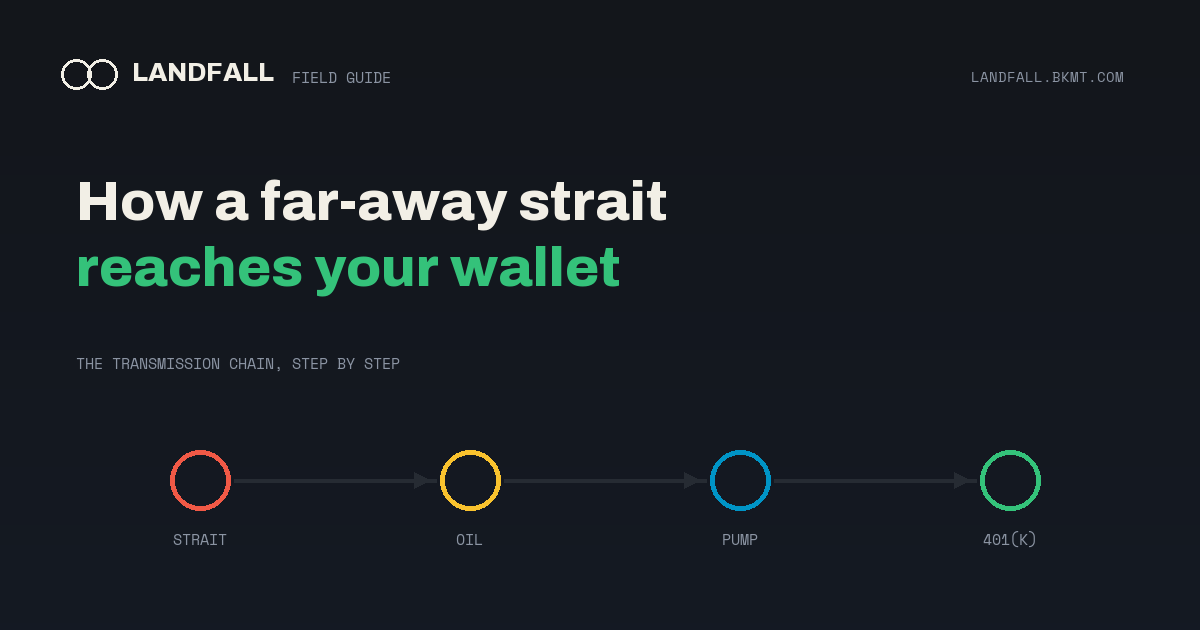
A drone hits a tanker eight thousand miles away and eventually, through a series of entirely mundane steps, your retirement account notices. The steps are the interesting part. None of them is instant, several of them are asymmetric, and at least one of them depends on what millions of strangers believe rather than anything you can photograph from a satellite. Here’s the chain, link by link.
Link 1: the strait → crude prices (hours)
Oil traders do not wait for barrels to actually go missing. The moment a disruption looks plausible, the price of Brent crude, the world benchmark, moves, because a futures contract is just a bet about supply, and threats change bets. This link is nearly instantaneous and often overshoots in both directions: prices spike on fear and sag on relief, sometimes while physical traffic through the strait hasn’t changed at all. That gap between the water and the ticker is precisely what Landfall’s divergence read measures.
Link 2: crude → the pump (weeks, and asymmetric)
Gasoline is mostly crude plus refining, taxes, and retail margin, so pump prices follow crude with a lag of roughly two to six weeks. The lag is famously lopsided, the industry literature genuinely calls it “rockets and feathers”: stations raise prices fast when crude jumps and lower them slowly when it falls, because no station wants to be first to cut. In the current crisis, U.S. retail gas and diesel ran about 20-odd percent above their recent normal at the peak of pass-through (the live figure is on the dashboard’s Gas & diesel card). That’s the part of an oil shock you experience in person, weekly, with a receipt.
Link 3: the pump → the economy → your 401(k) (months, three doors)
Your portfolio doesn’t have a Hormuz line item. The shock arrives through three doors at once:
Door one, earnings: expensive fuel is a cost for airlines, shippers, and anyone who moves atoms, and a windfall for energy companies, index funds own both, so the net effect is a churn, not a verdict. Door two, the consumer: every dollar at the pump is a dollar not spent elsewhere; sustained gas spikes act like a small tax on everything else, which is why several past recessions had an oil shock lurking in the opening credits (the dashboard’s Recession-signal and Layoffs cards, the Sahm rule and weekly jobless claims, watch for exactly this turn). Door three, the big one, the Fed: if expensive oil convinces people that inflation itself is back, the Federal Reserve typically has to keep interest rates higher for longer even as growth weakens, and higher rates tend to compress what investors will pay for stocks. That’s the channel that turns a shipping problem into a broad market problem.
The tell for door three is inflation expectations, what the bond market thinks inflation averages over the next five years. The 1970s became the 1970s because expectations broke loose; 2022’s spike didn’t, because they held. As of mid-2026, with the strait still visibly disrupted, expectations have stayed anchored near 2% (the dashboard’s Inflation-expectations card), the market’s way of saying “temporary.” It has been wrong before. It has also, annoyingly, often been right.
So… should you do something?
This is the paragraph where a different kind of website would tell you to buy oil stocks, or gold, or a newsletter. Landfall is deliberately not that website, a lighthouse, not an oracle. The honest summary of this whole page is: the chain is real, every link has a lag, and the largest link runs through beliefs rather than barrels. What a regular person can usefully do is see the chain clearly, watch whether the physical disruption is actually escalating, and whether it has actually started reaching the market gauges, which is the one thing the dashboard is built to show, for free, with the methodology public. What you do with that visibility is between you and, if you’re lucky, a licensed professional who knows your situation.
Keep reading
What happens if the strait closes · How much oil rides through Hormuz · The glossary. Not financial advice, plumbing.